Nobody Says "Cloud-Based SaaS Platform" Anymore

There was a year when “cloud” was the whole pitch
I started selling technology in 1999. I built what I believe was Canada’s first cloud computing company, at a time when saying the word “cloud” in a boardroom still required a diagram.
For about three years, “cloud-based” was the pitch. It was on every slide, in every headline, in every fund’s thesis. Founders led with it because it was the thing that made you sound like the future.
Then it stopped working. Not because cloud failed — because cloud won. It became plumbing. Today nobody walks into a room and says “we’re building a cloud-based SaaS platform,” because the sentence carries no information. Of course it’s cloud-based. What else would it be? The enabling technology became invisible, and the moment it did, the only remaining question was the one that always mattered: what does it actually do for someone?
AI is at the exact point on that curve where cloud was around 2011. And the entire industry is behaving as if the word itself is still the product.
We turned ourselves into their marketing department
Open your feed on any given morning. Somebody has shipped a new skill. Somebody has a new agent. Somebody has a framework that will change everything, again, for the fourth time this quarter.
Ask the obvious question: where is that running?
On OpenAI. On Anthropic. On Google. The skill is a thin wrapper, the agent is a prompt with ambition, and the compute underneath belongs to three companies in California. An entire generation of builders has volunteered to do the world’s most effective unpaid marketing campaign — for the exact companies whose pricing, deprecation schedules and outage windows they do not control.
I am not being cute about this. On September 3, 2026, Anthropic, OpenAI, xAI and Google all had overlapping service disruptions inside a few hours. Claude was down roughly three hours. Grok roughly three and a half. ChatGPT a little over two. Google’s was shorter and never confirmed by Google. The analyst note afterwards contained the only sentence anyone needed to read: “A multi-model strategy isn’t resilient unless its alternatives fail independently.”
Meanwhile, in a survey of 542 US executives, 81% reported at least some concern about vendor dependency — 29% of them very concerned. 89% believed they could switch providers within a month. Of the ones who had actually tried, 58% hit failures or unexpected effort. That gap between what people believe and what people experience is where a lot of companies are going to get hurt.
And the noise keeps rolling. A new skill every day. Nobody asking the only question that matters: what is your value, and will it still exist in twelve months?
The money is skipping the stage where innovation actually happens
Here is what the capital picture looks like once you strip the headlines out.
In North America in 2025, late-stage funding grew 75%. Early-stage grew 5%. Seed funding shrank. Not “grew more slowly” — shrank, in absolute dollars, in the middle of the biggest technology boom in a generation.
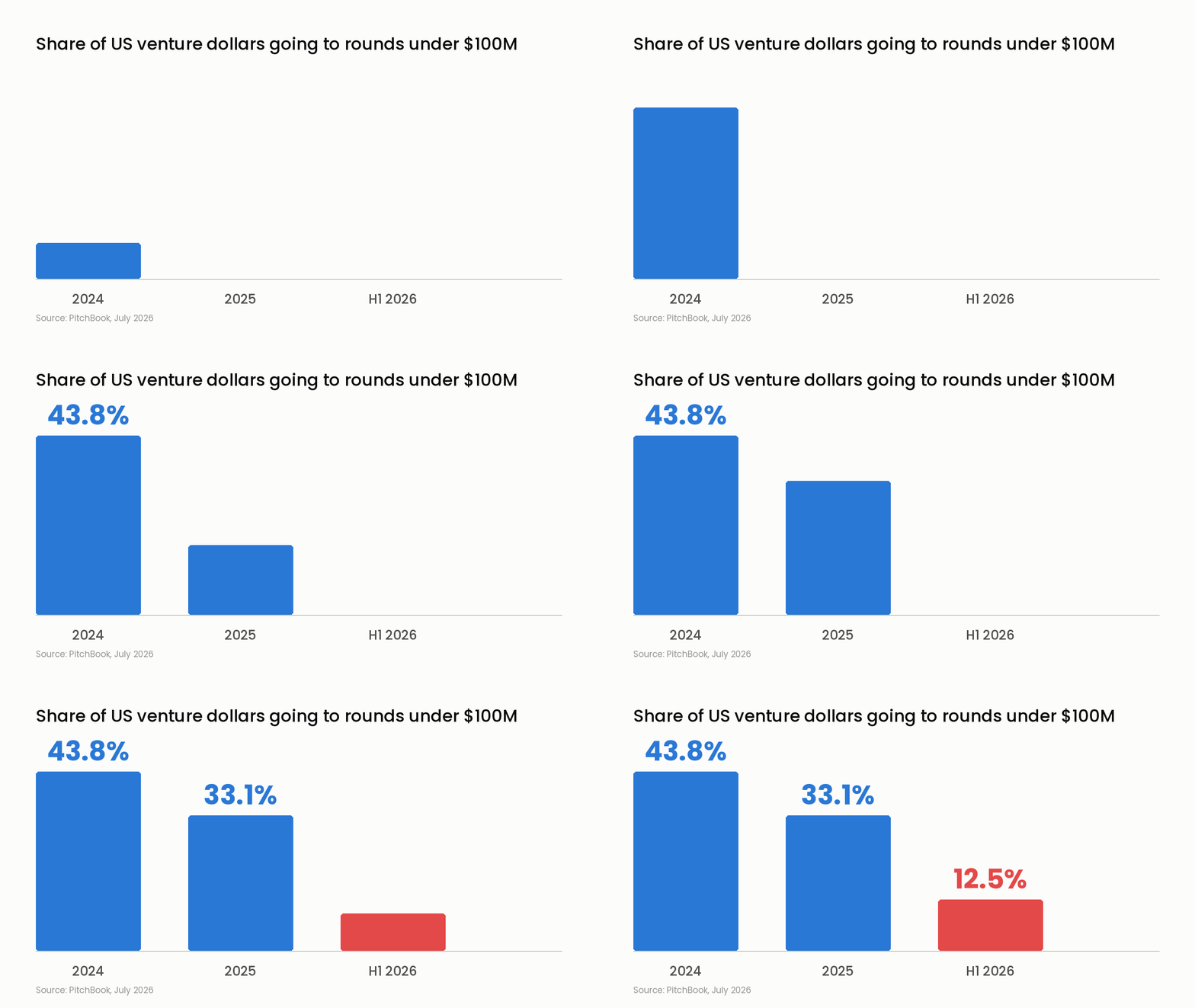
It got sharper this year. Rounds of $100M or more took 87.5% of all US venture dollars in the first half of 2026. Everything below $100M — which is to say, every ordinary company at the stage where products are actually invented — split the remaining 12.5%. That share was 43.8% in 2024 and 33.1% in 2025. Two years, a two-thirds collapse.
The median US seed round is $3 million and has barely moved in two years. In the same window, individual seed rounds closed at $1 billion, $1.03 billion, $1.1 billion, and one at $2 billion. Pre-product. Sometimes pre-idea.
I won’t name companies, because the pattern is the point and the pattern is documented. Products eight months old, raising at multi-billion valuations. Coding tools whose entire public existence is shorter than most enterprise procurement cycles, raising at fifty-plus times revenue. I’m not saying those teams aren’t good. I’m saying the capital is being allocated on narrative velocity, not on whether anything was commercialized.
In Canada it’s the same shape, smaller. 84% of venture funding into Canadian AI companies went to rounds of US$25M or more, up from 77%. Pre-seed, seed and incubator rounds all declined. The average Canadian pre-seed round is $880,000. And the funds themselves are concentrating: in 2025 the top five Canadian VC funds raised 80% of all LP capital committed, up from 46% in 2023.
Now the part that should bother every Canadian in this industry.
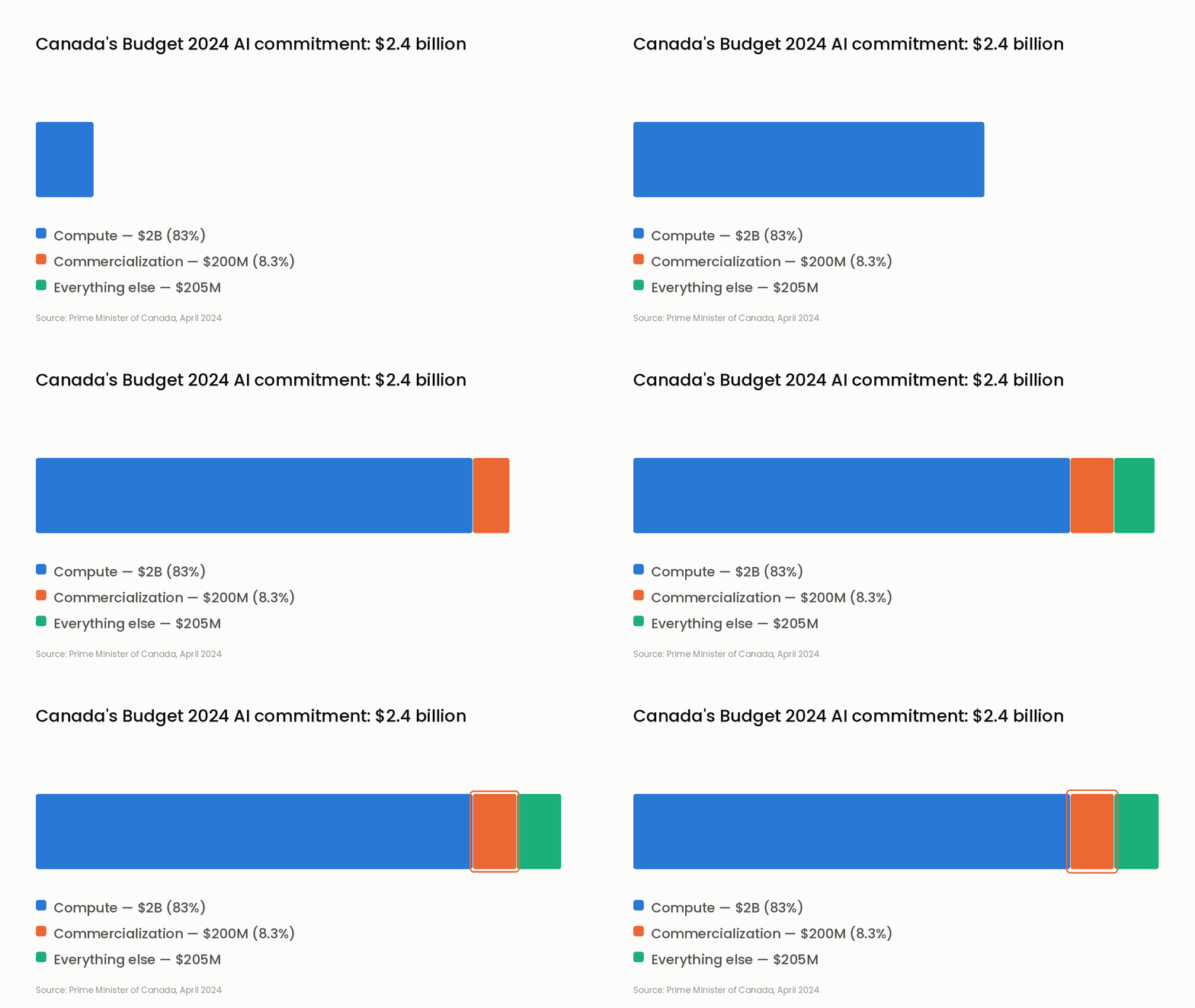
Canada’s federal AI commitment in Budget 2024 was $2.4 billion. Of that, $2 billion — 83% — went to compute. The line for commercialization and adoption through the regional development agencies was $200 million. 8.3%. The June 2026 “AI for All” strategy added another $2.3 billion, again weighted toward compute and scaleup capital, with most outcomes targeted at 2031.
This month, the Government of Saskatchewan announced the expansion of a private data centre campus near Regina — a 1.2 gigawatt build, phased over years — bringing its total estimated capital investment past $50 billion. It is billed as the largest private-sector capital investment in Canadian history.
One campus. Fifty billion dollars.
The entire federal commercialization line from Budget 2024 is 0.4% of that one project.
Now, in fairness — and I want to be fair, because I’d rather be argued with on the real numbers than on a strawman — the 2026 strategy does more here. It carries $500 million for the Regional AI Initiative and $130 million for commercialization across the national AI institutes. That is a genuine improvement over Budget 2024.
It is also still a rounding error next to the concrete. We are pouring foundations and buying GPUs at a scale measured in tens of billions, and funding the translation of Canadian research into Canadian companies at a scale measured in hundreds of millions. And then we hold conferences about why Canada doesn’t commercialize.
The top models have converged — and that changes the whole bet
Let me be careful here, because this is where most people writing about AI overreach and get taken apart in the comments.
I am not going to tell you models have stopped improving. They haven’t. Epoch AI published a study in April 2026 finding that capability progress has accelerated on three of its four metrics, with reasoning models showing both a one-off jump and a trend roughly two to three times faster than what came before. Anyone claiming a flat-out plateau is measuring the ruler, not the thing. Epoch’s own caveat is worth repeating, though: that acceleration is concentrated in programming and mathematics, where correctness is cheap to verify automatically, and may not generalise to the work most businesses actually need done.
What has happened is different, and more important commercially: the top has converged.
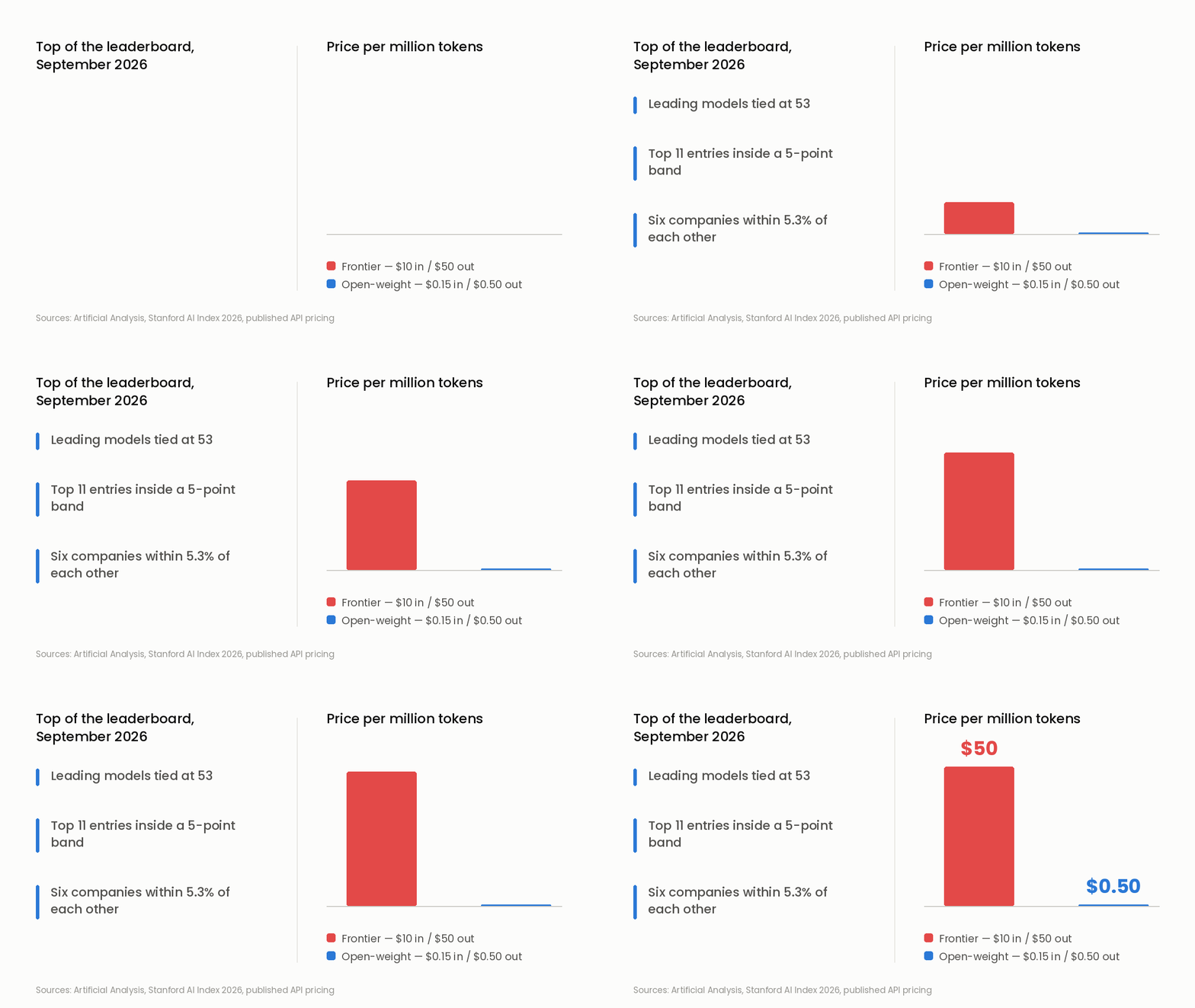
As of this month, the two leading models on the Artificial Analysis intelligence index are tied at 53, and the entire top eleven entries sit inside a five-point band. On Epoch’s capability index the top three sit at 166, 164 and 162. In the Arena rankings, the top four models are separated by fewer than 25 Elo points, and six different companies occupy the top tier, within 5.3% of each other.
No single model wins everywhere. One leads on mathematics. A different one leads on software engineering. Fifteen models score above 87% on the benchmark most buyers have actually heard of.
Now put the price next to it. Frontier models run around $10 per million input tokens and $50 output. Cheap and open-weight models run $0.15 input, $0.50–0.60 output. That is roughly 70x on input and 80 to 100x on output. And the price of any fixed capability level is falling 5x to 10x per year, while the cost of running the frontier itself is rising 3x to 18x per year.
Read those two facts together, because together they’re the whole argument:
Measured capability at the top is converging. Price is diverging by two orders of magnitude.
Anyone who has tied their product to one model provider has made a bet that gets worse every quarter — on a difference that is shrinking, at a price that is climbing, with a vendor who can deprecate the model out from under them. In January 2026, one provider retired four models from its consumer interface on fifteen days’ notice. The API was untouched that time — but the precedent is now on the record, and nobody building on top of these platforms got a vote.
The market already knows. In Datadog’s telemetry across organizations running LLMs in production, over 70% now run three or more models, and the share running six or more nearly doubled year over year. On one enterprise platform, two models accounted for 90% of usage in early 2025; by December, three models each held above 10% and the leader was down to 23%. One routing platform went from 5 trillion to 25 trillion tokens a week in six months.
And the hardware arrived in parallel. You can put 200-billion-parameter models on a desktop machine now. Someone ran a trillion-parameter open model across four consumer desktops over ethernet. Apple ships 512GB of unified memory and says plainly that it runs models with hundreds of billions of parameters entirely on device. NVIDIA — the company with the most to gain from centralized inference — now ships a free, open-source router that distributes inference across machines on your local network.
When the picks-and-shovels vendor ships the tool for running models locally, the direction is not ambiguous.
So what actually holds its value?
If the model is converging and commoditizing, and the skill you wrote this morning can be rewritten by somebody else tonight, then neither of those is your business.
Here is the test I’d apply to anything you’re building: in twenty-four months, when the model layer is plumbing and the word “AI” carries no information in a pitch — exactly like “cloud-based” today — what do you still have?
For us the answer is two things, and neither of them is a model.
The spec. Not a document nobody reads — the actual act of deciding what gets built before anything gets built. Hand any model a one-line idea and it will confidently fill in a hundred decisions you never made: the data model, the auth rules, what happens when two users collide, which edge cases matter. It will not tell you it guessed. You find out in week three, when the whole thing has to come apart. That judgment is what senior engineers have always sold, and no amount of generation capacity replaces it. It gets more valuable as code gets cheaper, because the cost of building the wrong thing quickly has never been higher.
The pipeline. Idea to spec to working product, end to end, with the decisions captured at every step so the next change doesn’t start from zero. Most tools give you one slice and leave the seams to you. The seams are where projects die.
That’s what Codalio Studio is, and it is deliberately model-agnostic. Plan on a cheap model. Execute on an expensive one. Run whatever is best for the task this month, swap it when that changes, run it locally when the rules require it. That isn’t a feature we bolted on — it’s the only architecture that makes sense once you accept that the model layer converges and the prices don’t.
Every serious Canadian conversation about sovereignty points the same way. TELUS is building sovereign AI infrastructure that will scale to over 60,000 GPUs by 2032, owned, operated and governed entirely within Canada. That commitment only means something if the software on top can actually run on it — which a product welded to one American API cannot.
The part I’d like people to argue with
I’m not asking anyone to stop using frontier models. We use them. They’re extraordinary.
I’m asking for something harder: stop leading with the enabling technology and start leading with the value.
Stop announcing another skill. Stop shipping another agent that is a prompt with a job title. Ask instead what you know, what you’ve built, and what you’d still have if all three major labs changed their pricing tomorrow — because one of them will.
And to the people allocating capital, particularly in Canada: the innovation is not happening in the eleventh megaround of the year. It’s happening in rooms where somebody is turning a real problem into a real product with almost no money. One percent of what is going into concrete and GPUs, redirected to commercialization, would change more than the other ninety-nine.
We’re building in Sudbury. Seven years in. We don’t have the charisma of a $50 billion announcement.
We do have a thesis, and it’s this: the companies that matter in 2028 will be the ones who bet on their own judgment instead of somebody else’s model.
Sources
Venture capital concentration
- Crunchbase News, “North American Startup Funding 2025” — late-stage +75%, early-stage +5%, seed −9%. Jan 8, 2026. https://news.crunchbase.com/venture/north-american-startup-funding-2025-data-ai-us-investment/
- SiliconANGLE / PitchBook — $100M+ rounds took 87.5% of US venture dollars H1 2026; sub-$100M share fell 43.8% → 33.1% → 12.5%. Jul 9, 2026. https://siliconangle.com/2026/07/09/pitchbook-us-venture-funding-hits-412-7b-first-half-ai-deals-dominate/
- PitchBook, “Mega seed rounds make headlines” — US median seed $3M; $1B+ seed rounds. May 15, 2026. https://pitchbook.com/news/articles/mega-seed-rounds-make-headlines-and-potentially-hurt-startups
- Crunchbase News — largest seed ever, $2B. Dec 12, 2025. https://news.crunchbase.com/venture/record-breaking-seed-funding-us-ai-eoy-2025/
Canada
-
Prime Minister of Canada, “Securing Canada’s AI” — Budget 2024’s $2.4B: $2B compute, $200M commercialization. Apr 7, 2024. https://www.pm.gc.ca/en/news/news-releases/2024/04/07/securing-canadas-ai
-
BetaKit — “AI for All” strategy, $2.3B. Jun 4, 2026. https://betakit.com/canadas-ai-strategy-contains-2-3-billion-in-spending-few-details-on-new-privacy-regulations/
-
Government of Saskatchewan — $52B private data centre investment, largest in Canadian history. Sep 14, 2026. https://www.saskatchewan.ca/government/news-and-media/2026/september/14/single-largest-private-sector-capital-investment-in-history-of-canada-through-bell-ais-saskatchewan
-
Osler — 84% of Canadian AI VC to rounds US$25M+; seed and incubator rounds declined. Mar 2, 2026. https://www.osler.com/en/insights/updates/capital-concentration-pe-opportunity-canadian-ai-market-2025/
-
RBCx Canadian VC 2026 Mid-Year Report — top 5 funds took 80% of capital, up from 46% in 2023. Jun 24, 2026. https://www.rbcx.com/ideas/startup-insights/canadian-venture-capital-report-2026-mid-year/
-
BetaKit / CVCA — Canadian pre-seed average deal size $880K. Feb 19, 2026. https://betakit.com/capital-concentrates-as-canadian-vc-market-narrows-report/
Model convergence
-
Epoch AI, “Latest” — capability index top three at 166 / 164 / 162. Sep 16, 2026 (accessed Sep 17, 2026). https://epoch.ai/latest
-
Artificial Analysis LLM Leaderboard — top three tied at 53; top eleven within five points. https://artificialanalysis.ai/leaderboards/models (accessed Sep 17, 2026)
-
Stanford HAI, AI Index Report 2026, Ch. 2 — top four within 25 Elo; six companies inside 3.3%; 15 models above 87% on MMLU-Pro. https://hai.stanford.edu/assets/files/ai_index_report_2026_chapter_2_technical.pdf
-
Epoch AI, “Have AI Capabilities Accelerated?” — the honest counter-evidence. Apr 16, 2026. https://epoch.ai/publications/have-ai-capabilities-accelerated
Pricing
-
OpenAI API pricing. https://developers.openai.com/api/docs/pricing
-
Anthropic pricing. https://platform.claude.com/docs/en/about-claude/pricing
-
Together AI pricing — open-weight tier. https://www.together.ai/pricing
-
Gundlach, Lynch, Mertens & Thompson, “The Price of Progress” — price for a given capability falls 5–10x/year; frontier cost rises 3–18x/year. arXiv, rev. Mar 23, 2026. https://arxiv.org/abs/2511.23455
Lock-in, outages, multi-model
-
Info-Tech Research Group — overlapping outages across four providers, Sep 3, 2026. Sep 4, 2026. https://www.infotech.com/software-reviews/vendor-technology-notes/overlapping-ai-outages-expose-an-enterprise-resilience-gap
-
Zapier — 81% concerned about vendor dependency; 89% believe they could switch in a month; 58% of those who tried hit failures. Apr 1, 2026. https://zapier.com/blog/ai-vendor-lock-in-survey/
-
Datadog, “State of AI Engineering” — 70%+ of organizations deploy three or more models. Apr 21, 2026. https://www.datadoghq.com/state-of-ai-engineering/
-
Perplexity Enterprise — concentration collapse through 2025. Feb 3, 2026. https://hub-prod.perplexity.ai/hub/blog/inside-the-rise-of-enterprise-ai-model-switching
-
OpenRouter — 5T → 25T tokens/week in six months. May 26, 2026. https://www.businesswire.com/news/home/20260526953416/en/OpenRouter-Raises-$113-Million-CapitalG-led-Series-B-as-Weekly-Volume-Explodes-to-25T-Tokens
-
OpenAI, “Retiring GPT-4o and older models” — 15 days’ notice. Jan 29, 2026. https://openai.com/index/retiring-gpt-4o-and-older-models/
Local inference
-
NVIDIA — DGX Spark, 200B-parameter models on a desktop. Oct 13, 2025. https://nvidianews.nvidia.com/news/nvidia-dgx-spark-arrives-for-worlds-ai-developers
-
AMD — one-trillion-parameter model across four consumer desktops. Feb 25, 2026. https://www.amd.com/en/developer/resources/technical-articles/2026/how-to-run-a-one-trillion-parameter-llm-locally-an-amd.html
-
Apple Newsroom — M5 Ultra, 512GB unified memory, “hundreds of billions of parameters entirely on device.” Aug 25, 2026. https://www.apple.com/newsroom/2026/08/apple-introduces-m6-and-m5-ultra-for-a-big-leap-in-performance-and-ai-compute/
-
NVIDIA Blog — PAIR, free open-source local inference router. Sep 3, 2026. https://blogs.nvidia.com/blog/local-ai-ifa-next-gen-agents-nv-pair-rtx-spark/
Sovereign AI
- Newswire — TELUS and Government of Canada, 60,000+ GPUs. May 11, 2026. https://www.newswire.ca/news-releases/telus-and-government-of-canada-advance-work-to-scale-canada-s-sovereign-ai-infrastructure-854223505.html