What Canadian Founders Need Before Applying to ventureLAB's Hardware Catalyst

What does ventureLAB's Hardware Catalyst actually ask founders for?
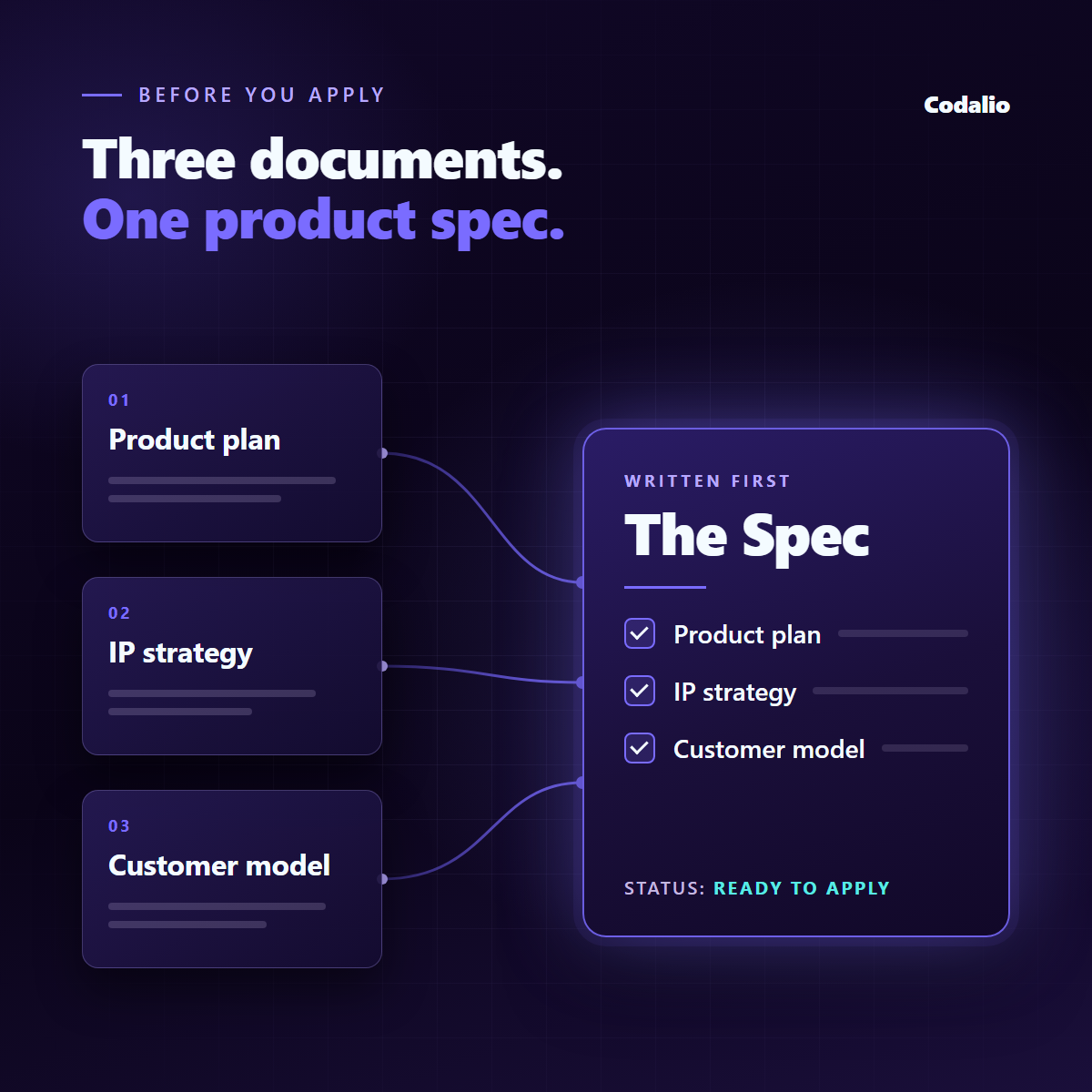
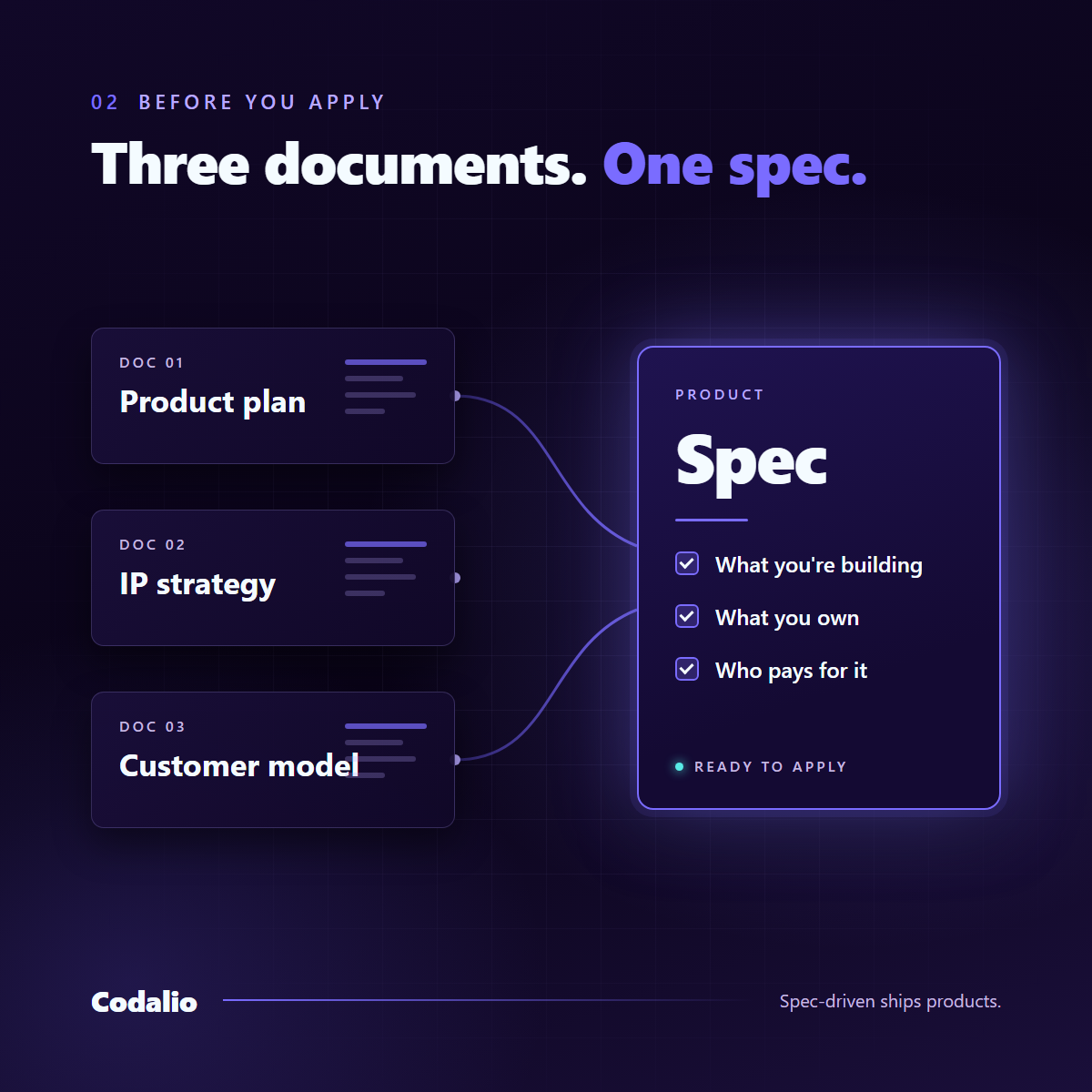
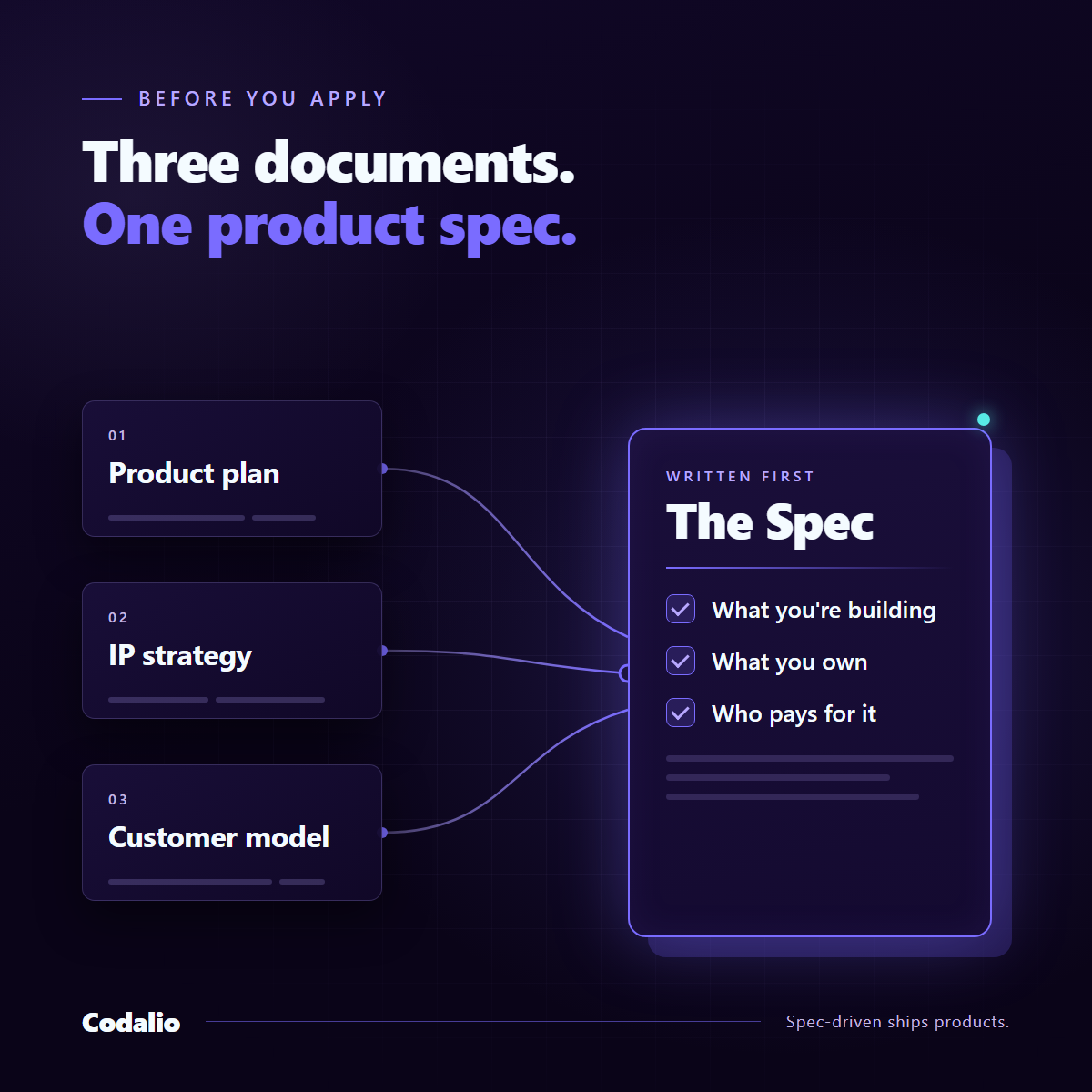
Before you apply to ventureLAB's Hardware Catalyst Initiative, you need three things in writing: a product plan, an IP strategy, and a customer-engagement model. Together, those three documents make up a product spec. Founders who write the spec first can build the application in a day. Founders who skip it can spend a month on it.
The timing matters. ventureLAB has reopened applications for its Markham-based Hardware Catalyst Initiative, backed by $4.5M from FedDev Ontario. It's open to companies under five years old with under $5M in revenue. Around the same time, Propel moved its Atlantic Canada accelerator to continuous intake. For Canadian founders, that means more open doors and less waiting.
More open doors don't mean easier entry. Both programs screen on how clearly you've defined your product. They don't screen on how much code you've written.
Why non-technical founders lose points before anyone sees a prototype
Most founders prepare for an accelerator application the way they'd prepare for a demo day. They polish the prototype, record a walkthrough, and tighten the pitch. Then they reach the application form and find questions the prototype can't answer. Who exactly is the first customer? What do you own, and how do you protect it? What does version one do, and what does it deliberately leave out?
These questions come from product definition, not engineering. Non-technical founders often assume a working demo will do the explaining for them.
It won't.
A prototype shows that something can be built. A reviewer wants to know that you know what you're building, for whom, and why it's defensible. Those are separate claims, and only the second one is scored.
The gap is wider for hardware-adjacent companies. A semiconductor or device startup still ships software, such as a companion app, a device dashboard, a data pipeline, or a configuration tool. If that software layer is undefined, the product plan has a hole in the middle. Reviewers who read many applications will notice it.
A Hardware Catalyst application is a PRD by another name
Look at what the reviewers ask for and compare it with a well-built product requirements document (PRD). They largely overlap. The product plan corresponds to the PRD's scope and roadmap. The IP strategy corresponds to its technical architecture and differentiation. The customer-engagement model corresponds to its user personas, problem statements and validation plan.
For the founder, that's good news. You don't need to invent a new document for each program. You need one clear source of truth that you can adapt for each application.
A spec that works for an accelerator application covers:
-
The problem and the customer. Name one specific buyer and the one pain you remove for them, not a market category.
-
Scope for version one. List what's in, what's out, and why the line sits where it does.
-
The technical approach. Describe the architecture in plain language, including where your IP lives and what's commodity.
-
How you'll engage customers. Explain how you find the first users, how you learn from them, and what would change your plan.
-
Success criteria. State what "working" means in measurable terms before you build anything.
This is Codalio's wedge in practice: vibe coding ships prototypes, and spec-driven work ships products. Tools like Lovable, Cursor and Replit are built to turn a prompt into working code quickly. They do that well. The spec, though, ends up being whatever the prompt happened to contain. That's fine for testing an idea. It won't hold up when a program reviewer asks you to explain your product decisions.
At Codalio, the workflow runs the other way round. The first step defines the business logic, the customer and the scope. The prototype comes after that and follows from it. The spec is the first thing you produce, not something you write up later.
How to prepare your application this week
You don't need a finished product to write a strong application. You need clear thinking in writing. Here's how to spend the week before you apply.
Day one: write the problem statement. Keep it to one paragraph: who the customer is, what they struggle with today, and what it costs them. If you can't write it without jargon, you aren't ready to write the product plan yet.
Day two: draw the scope line. List everything you want the product to do, then cut the list to what version one needs to prove the core value. Write down why each cut feature was cut. Reviewers read that reasoning as evidence of focus.
Day three: map your IP. Separate what you're building that's genuinely yours from what you're assembling from existing parts. Be honest about it. An IP strategy that claims everything is novel is less credible than one that shows exactly where the defensible part is.
Day four: define customer engagement. Name the first ten conversations you'll have, what you want to learn from each, and what answer would make you change direction.
By day five you'll have a spec. Reuse the same document for the Hardware Catalyst application, for Propel's rolling intake, and for your first engineering conversation. You'll save more than the week you spent on it, because you won't rebuild the product halfway through when the requirements turn out to be wrong.
Codalio is the AI platform that takes non-technical founders from idea to PRD to working prototype — without the rebuild cycles that come from skipping the spec.
Start with the spec, not the build
If you're preparing for Hardware Catalyst, Propel, or any program that scores product clarity, Codalio helps you turn your business logic into a structured spec before you commit to building anything. 15 minutes: https://calendar.google.com/calendar/u/0/appointments/schedules/AcZssZ1xoWYA0z_rrdr19ZThUrYVTIskY9LRkxD-ouIRGzBNV2L5GLJSaoofOVqdW5ls3IknzLUV5xzh
References
-
BetaKit: Propel unveils latest Atlantic Canada cohort; ventureLAB opens applications for semiconductor incubator
-
ventureLAB Hardware Catalyst Initiative (funded by FedDev Ontario)