

Industry explainer
What is an AI software factory?
Last updated September 26, 2026 · By Ehsan Mirdamadi, Co-founder and CEO
A software factory is a system that turns requirements into working, deployable software through a repeatable, governed pipeline instead of hand-crafted one-off builds. The term began as Microsoft's 2004 pattern for producing families of applications from shared, reusable assets; in 2026 it means an AI-run version of the whole software development lifecycle — planning, building, testing, review and release — where agents do the work and humans set the intent and govern the output. What separates one factory from another is what the agents build against. Autonomous factories run on signals from the codebase and improve themselves each cycle; a spec-first factory runs on a living specification — PRD, technical spec, data model — so the business intent, not the last commit, is the instruction set. Codalio is a spec-first AI software factory: you describe the product, it engineers the PRD and technical spec, then runs agents against that blueprint to produce production-grade code you own.
AI made generating code cheap. It didn't make generating the right code cheap. A specification is the only thing that tells the agents — and your engineers — what right means, and keeps it true as the product changes.
Software factories before AI (2004–2022)
The phrase is older than agents. In 2004 Jack Greenfield and Keith Short published Microsoft's Software Factories pattern: produce families of applications from shared, reusable assets — models, frameworks, and guidance — instead of crafting each system by hand. The factory was a method for industrializing variation, not a metaphor for typing faster.
Over the next two decades the idea showed up as DevOps platform teams and, in government, as named software factories. The U.S. Department of Defense stood up Kessel Run and Platform One so squadrons could ship on a shared pipeline with policy baked in. The constant across all of these: a repeatable, governed path from requirement to running software, with humans accountable for the output.
What changed with agents
Coding agents collapsed the cost of producing lines of code. The bottleneck moved from typing to specifying. An unanchored agent will happily invent a product that demos well and fails the business: it optimizes for the last prompt, not the intent that prompt was trying to express. That is the Token Casino — more retries, more tokens, a product that still is not the one you meant. See The Token Casino.
A specification is the control surface. Agents need something durable to build against — a PRD, a technical spec, a data model — that survives a new chat window. Without it, an agentic pipeline is just a faster way to build the wrong thing. With it, humans set intent and govern; agents execute.
The three models of AI software factory
By 2026 the term covers at least three designs. They agree that agents do the work and humans govern. They disagree about what the agents build against.
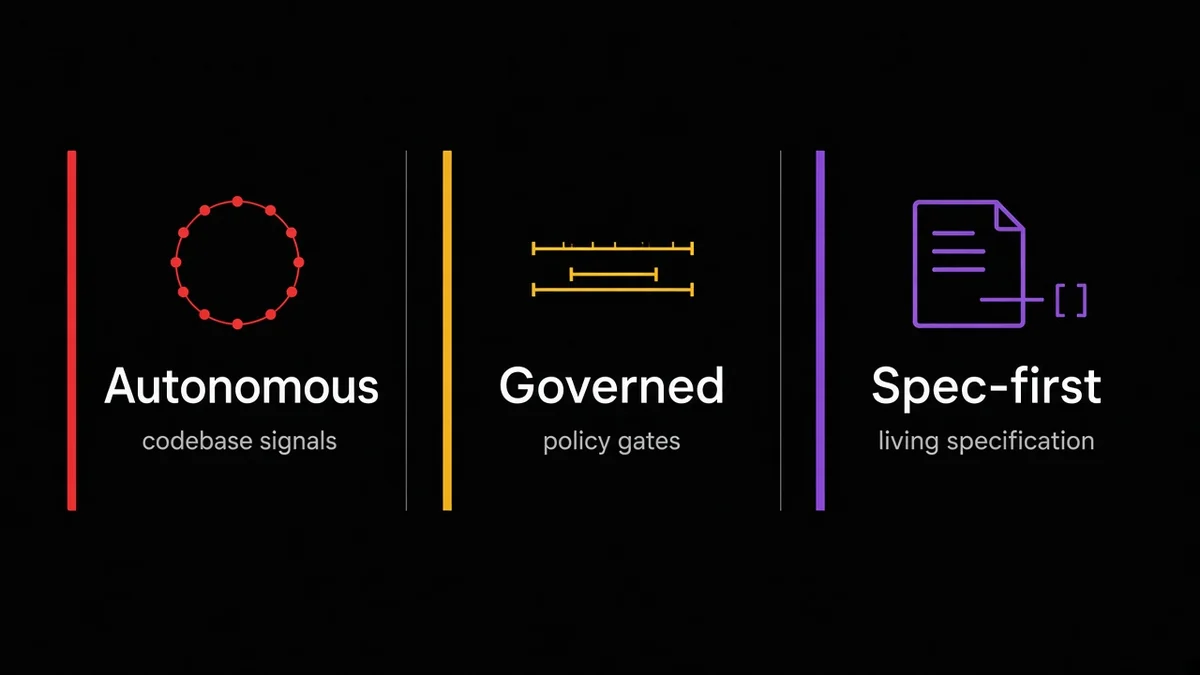
| AutonomousAgents self-direct; Factory.ai's framing | GovernedEnterprise platform teams with policy gates; BCG / TrueFoundry framing | Spec-firstA living PRD and technical spec are the instruction set; Codalio | |
|---|---|---|---|
| Who sets direction | The system, from codebase signals | Platform and risk owners | The business, via a living specification |
| What the agents build against | The last commit and runtime signals | Policy, tickets, and approved templates | PRD, technical spec, and data model |
| How drift is caught | Self-improvement loops; humans govern exceptions | Gates: security, compliance, architecture review | The spec is checked against the code as it is generated |
| Who owns the output | Usually the vendor pipeline; code may stay in-repo | The enterprise, behind its own controls | You — exportable production-grade code |
| Best fit | Platform teams optimizing an existing codebase | Regulated or sovereignty-sensitive organizations | Founders and teams who need intent, not the last prompt, to drive the build |
An autonomous factory (Factory.ai's phrase) is self-improving from codebase signals. A governed factory is an enterprise platform with policy gates. A spec-first factory treats the living specification as the instruction set. All three are legitimate; pick on instruction set and ownership, not on the word “factory.”
What a software factory must produce
Regardless of model, a factory that claims the full lifecycle should leave you with more than a chat log:
- Spec-Driven AI Scoping. A Product Requirements Document — the what and why
- Detailed Technical Spec. A technical specification — the how
- Refinements & Versioning. Versioning so spec and code stay paired
- Budget & Timeline Estimation. An estimate before the build starts
- UI Prototyping. A prototype you can click
- Data Model Creation. A data model
- Production-Ready Code. Production-grade code
- Shared Workspace. A shared workspace for owners and engineers
- DevOps & Hosting. A path to deploy
Software factory vs. AI app builder vs. coding agent
App builders optimize for the first screenshot. Coding agents optimize for the next edit. A factory optimizes for a repeatable path from intent to owned, deployable software. See the alternatives hub for tool-by-tool comparisons.
| Kind | Examples | What it does well | What it usually misses |
|---|---|---|---|
| AI app builder | Lovable, Replit, Bolt | Prompt to a demo UI, fast | A living spec, owned code, engineer handoff |
| Coding agent | Cursor, Claude Code, Devin | Edits code from a prompt or ticket | The PRD those agents should be coding against |
| Software factory | Spec-first, governed, or autonomous | Repeatable pipeline from requirements to deployable software | Nothing required — evaluate which instruction set it uses |
Worked example: a spec-first software factory
Codalio is the spec-first AI software factory: it turns a feature into a PRD, technical spec and production-grade code you own. You describe the product in plain language. Codalio engineers a PRD and a technical spec, then runs agents against that blueprint — prototype, production code, versioning, deploy — so the business intent stays the instruction set as the product changes.
In an April 2026 test, Codalio built 111 of 111 customer-facing requirements for $7.96; two prompt-only coding-agent runs of the same brief finished 49–51% at $25–$49.
L-SPARK selected Codalio for the TELUS Sovereign AI Accelerator; the same spec-first loop is what enterprise teams run when they need governed agent workflows and a living spec they can show an auditor. Eduai used the factory path to go from a training idea to a production product without rebuilding the spec after every demo. The loop itself is on how it works; the governed version is on enterprise.
How to evaluate one
- [ ]Does the spec stay in sync with the code?
- [ ]Is the code exportable — a repo you own?
- [ ]Can you run it on any cloud, or only the vendor’s?
- [ ]Is there a clean handoff to engineers?
- [ ]Do you get an estimate before the build starts?
- [ ]Is there a governance trail — who approved what?
- [ ]Is the core open source?
- [ ]Are the pilot terms written down?
Two ways to go further with Codalio
Once you know what to look for, these are the two ways to use Codalio: a governed factory fitted to your process, or the factory as it ships.
Enterprise
This is how you talk to Codalio about custom workflows and implementations. The factory is governed and fitted to your process and your constraints — the reviews, systems, and controls you already run — and it is arranged with the team. There is no self-serve signup.
Enterprise offeringCodalio Studio
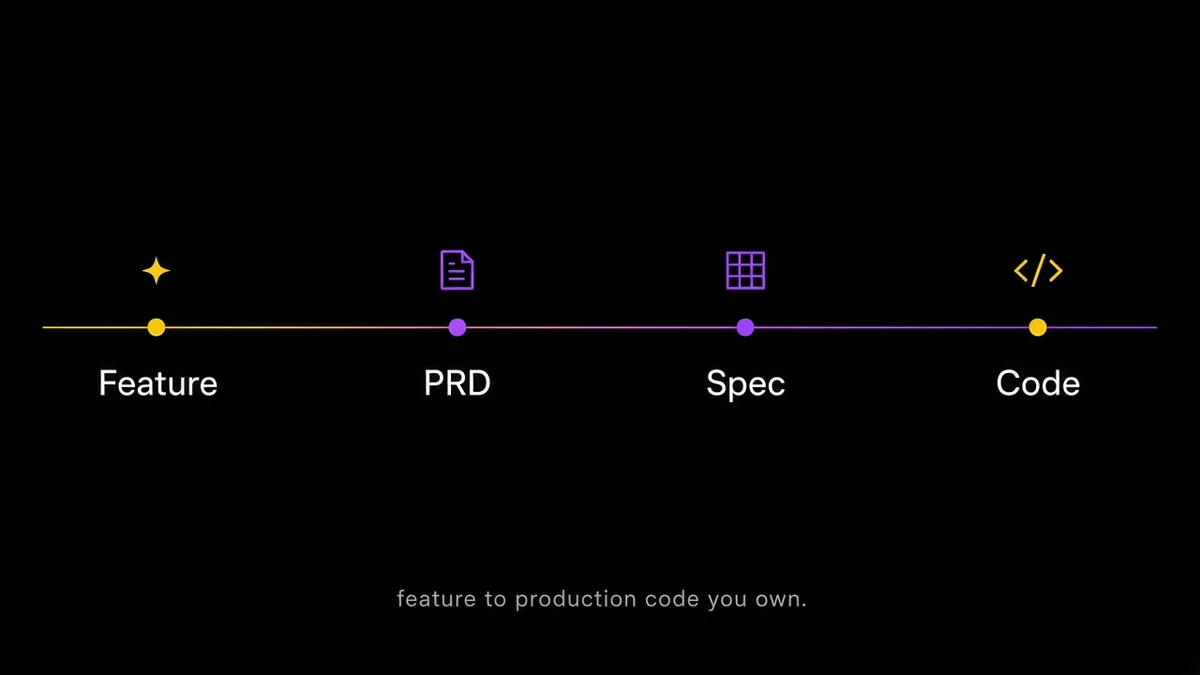
The software factory as it ships. You use it out of the box: a feature becomes a PRD, then a technical spec, then production code you own. That path includes the last mile — your models and your agents, on the same living spec.
Codalio Studio